Willow Home Page

Monday, May 16, 2016

Bunker Raking and Footprints

Care of the Course: Bunkers
"Before leaving a bunker, players should carefully fill up and smooth over all holes and footprints made by them and any nearby made by others. If a rake is within reasonable proximity of the bunker, the rake should be used for this purpose."
USGA Rules of Golf, Section I

Raking bunkers after your shot often seems pointless, after all you are out of the bunker and onto the green now. However its is important that the group behind yours finds the course in the same shape or better condition than you found it. The best part of fixing the bunkers is the example you set for the players to follow, and hopefully they will follow your lead.

The video below explains the proper way to enter and exit bunkers as well as how to rake your footprints behind you without moving too much sand. The most important aspect of this video is where to enter and exit the bunker.


Treat the course as if you are playing behind your group. Repair ball marks, rake bunkers and fix your divots.

Friday, May 6, 2016

Ball Mark Repair

With the beginning of the season here, it is important to remind people proper golf course etiquette. In section I of the USGA Rules of Golf handbook, repairing ball marks is clearly stated as follows:

"Repair of Divots, Ball Marks and Damage by Shoes: Players should carefully repair any divot holes made by them and any damage to the putting green made by the impact of a ball (whether or not made by the player himself). On completion of the hole by all players in the group, damage to the putting green caused by golf shoes should be repaired."
-USGA Rules of Golf Section I

The grounds crew searches for and repairs ball marks every morning left behind from the previous days play. If not repaired, the ball marks can take weeks to fully recover leaving unsightly damage. Repairing ball marks properly directly affects the aesthetics and more importantly the play ability of the green. Any sharp object can be used as a ball mark repair tool.

Below is an informative video that shows the right and wrong ways to repair ball marks. Please take a few minutes and use this video as a refresher for the upcoming season.


Thursday, April 14, 2016

Aeration, Verticutting and Topdressing

The wet start to spring the past two weeks has posed many challenges for us, especially in regards to aerating the greens and fairways. The poor weather forced us to get creative. We needed to remove organic matter from the greens, but also had to take into consideration whether the greens will heal quickly while minimizing disruption to play. Our solution was twofold, aerate the greens with solid tines and follow up by verticutting the greens. The solid tines do not remove any material from the greens making the operation much less disruptive. The verticutting does remove organic matter from the greens while minimizing disturbance to the putting surface.

The process involved multiple teams of Willow Ridge employees to synchronize their work in order to efficiently cultivate the greens. It begins with mowing the greens so that we start with a clean and even surface. As soon as the mowers were finished the aerator starts to punch holes into the greens. The solid tines help to alleviate compaction in the soil and improve soil qualities.

After the aerator is finished on the greens it is time for the verticutter. This machine uses many vertical blades that act as a saw blade to pull organic matter out of the surface. The organic matter is left on the greens and needs to be blown off and removed. The open grooves allow sand to be incorporated into the surface of the green eliminating grain and providing firmer conditions.
Verticutting
Blowing off debris from verticutting
Grooves from verticutting before topdressing
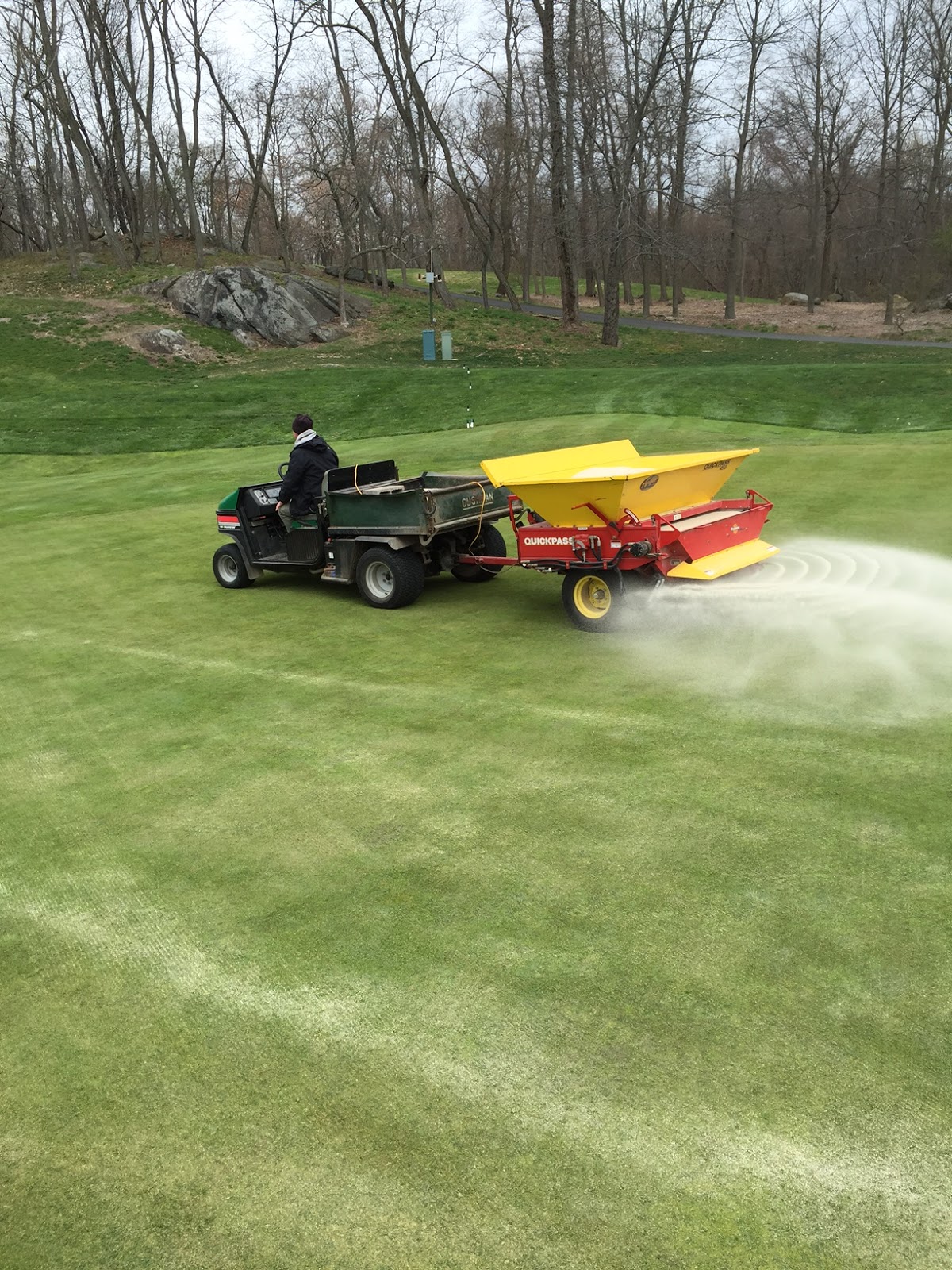
Once the verticutting is finished, we topdress the greens with sand in order to fill in the grooves. The sand is brushed in with a tow-behind brush to ensure its spread equally across the greens. Sand is spread on the greens to help dilute organic matter and to ensure the greens are true and uniform.

Topdressing
Brushing the topdressing into the grooves
We understand that aerating the greens can be disruptive to the golfers. However it is imperative that we continue this process to ensure the long term health of the greens. We thank you for your patience while we strive to provide the best playing conditions possible. Within 7-10 days the greens will be healed and ready for another great season.

Final result with small aeration holes and verticutting grooves filled with sand

Tuesday, April 5, 2016

New Sod Updates

With the warmer weather looming we have begun to install sod on our winter projects. The fourth tee is completed and currently growing in. The temporary tees are located in front of the forward tee for the red, gold and white tees and behind the back tee for the blue tee. Due to the amount of play seen in the late fall and early spring, the forward tee was being over played with minimum recovery. Because of this we temporarily closed the forward tee so that both tees can be opened under optimum conditions. The good news is that both tees will be open for play in just a matter of weeks.

4th tee
The seventeenth middle tee has its playing surface completely sodded with a majority of the rough sod around the edges in place. By having the playing surface sodded already we will be able to open the tee up sooner. Currently the white tee markers have been moved up to the forward tee.

17th tee
The fairway expansion and rough to the right of 8 green has also been fully sodded. This project began with the removal of a rotting oak tree. With the tree gone the area was not pleasing to look at and offered little in terms of play. A small mound was constructed to challenge golfers and provide better aesthetics. The right side of 8 also had new irrigation installed which will keep the rough dense and lush throughout the season. The fairway has also been expanded to the right of the approach. It is important to remember to keep off of new sod while it is rooting to the ground, please follow all signs and markers to direct traffic. The current path to the green from the cart path is to go around the back right bunker.

Right side of 8th green from cart path
Right side of 8th green from fairway


Monday, March 14, 2016

Winter Overview

Spring came quickly this year with the earliest opening day Willow Ridge has seen. We hope you all enjoyed the course last weekend as we put extra effort into getting the course playable. The past few months have been mostly favorable towards working outside and getting plenty of work done on the course.

The area between 11 fairway and the beginning of 12 fairway was consistently wet this past season. We identified a major trunk drain that was clogged with tree roots and sediment. This drain clears water from a large area of the course all the way up to the driving range. After finding the problem we cleared it and restored the drain. Now the water flows efficiently without backing up to the surface.
Working to clear a path for the water

Detail of the new connection
The bushes and brush in front of the white/blue tee on number 4 have been cut back in order to give a better sight line to the green. The area in front of the 5th blue tee was also cleared out to enhance the aesthetics and play ability off the tee.


Improved sight line from the 4th white/blue tee
Improved sight line from the 5th blue tee
A lot of work was done on the white tee on 17 as well as the white/blue tee on 4. We stripped the sod and began leveling off the tee. Both tees will be slightly larger than before and are better aligned towards the direction of play. The tees have yet to be sodded as we wait for more warmer weather.

17 white tee waiting for final prep and sod

4 blue tee during the leveling phase

By the 8th green the large oak tree to the right has been removed because it was rotting and in poor health. New irrigation will be installed along the right side of the hole both in front and behind the bunker. The removal of the tree will offer more sunlight to the turf, in conjunction with the irrigation conditions will be vastly improved.
Rot in the center of the oak tree by 8 green

Area around the 8th green that will see new irrigation and sod

Monday, October 19, 2015

Winter Weather and Frost Delays

With the changing weather comes changes in management practices here at Willow Ridge. Particularly in regards to frost delays caused by freezing temperatures and cold fall nights. The frost alone is not damaging to the turfgrass, but walking and running equipment over the grass can be extremely damaging.


The putting greens, maintained at such low heights of cut are very susceptible to damage when they are covered with frost. This is because the leaf blades which are 90% water become covered in ice crystals. When walked on, the the ice crystals are likely to puncture and rupture the cell walls of the plant. Often times symptoms do not manifest for 24-48 hours where a dead footprint will appear. Not only are the greens susceptible to frost damage, all of the turf can be killed when walked on with frost. This includes not only tees, fairways and approaches but the rough as well.

Damage resulting from walking on frost covered turfgrass
While frost delays can be an annoyance, it is important for everyone to understand the reasoning behind them. Walking on the greens before the frost has melted can cause irreversible damage resulting in unneeded repairs. When there is a frost delay, information can be found by calling the golf hotline. The management staff is in close contact with the first tee during frost delays ensuring golf can begin as soon as favorable conditions return.


Friday, July 31, 2015

Lightning Detection System and Saftey

Here at Willow Ridge we have an Electric Storm Identification Device coupled with four sirens on the course. This device can detect when lightning is in the area and alert golfers and employees of the eminent danger. The alarm sounds when lightning is between 0-5 miles from Willow Ridge, meaning the storm is close. The alarm is a solid tone indicating everyone to take shelter immediately, there is no telling if the lightning is on top of us or 5 miles away.


When the alarm goes off drop what you are doing and head to the nearest shelter, if you cannot get back to the clubhouse, maintenance facility or the bathroom on the course it is advisable to find a thick growth of small trees in the woods. Stay away from wire fences, metal pipes, rails, isolated trees, and other equipment.

There is also a two-toned alarm indicating that there has been no lightning strikes in past 15 minutes. It is important to stay alert and cautious during this time because it does not indicate the storm is gone or that everything is clear, it is only an indicator that there has not been a lightning strike within 5 miles for 15 minutes.


This past year the United States had 26 lightning strike fatalities according the National Weather Service. It is extremely important to stay aware of the weather and know what the lightning detection alarm sounds like and how to react. There are four loud speakers that sound when the alarm goes off, located by the first green, the seventh tee, the sixteenth tee and by the maintenance facility.

Friday, July 24, 2015

New Pump

A new booster pump has been installed giving the irrigation system an important upgrade. The old pump was nearly 20 years old and on its last legs. Attempts to repair the pump to get through the season were met with unavailable parts, meaning if the pump was to fail we would be out of luck and with inadequate water available.
Old Booster Pump

The irrigation pump is the heart of the golf course water system, providing the necessary water to much of the golf course. Without the pump, keeping the course green and alive becomes a impossible. It is likely that a lot of our managed turf would stress, becoming brown and dead. The pump is an often overlooked feature of the golf course, when it breaks down everybody can see the results.

New Booster Pump
The new booster pump is state of the art, with computer controls that give us more flexibility to manage the watering schedule. The new pump is more efficient than the old one, and at the same time can output more water. The biggest advancement the new pump has over the old pump is a feature called Variable Frequency Drive(VFD). The old pump is comparable to a light switch, it has two modes On and Off. The new pump is akin to a dimmer switch, there is a sliding scale between On and Off. The pump automatically adjusts its power level and water out to meet demand most efficiently. VFD is a major factor in the reduction of electric costs surrounding the pump station.


New Booster pump internals

Friday, July 3, 2015

Divots, Divots, Divots Everywhere

Divots on the golf course are a common and normal occurrence that we must appropriately manage to ensure a quick and efficient recovery. All of the golf carts are equipped with a green sand mix in divot repair bottles to help us fill divot on the course. The reception of the divot repair bottles has been exceptional and has helped us cut down on tedious divot repair jobs. However, there are generally two types of divots found on the course, and they need to be taken care of in different ways.
Divots of all types, sizes and shape
Thin divots with no soil attached should be filled with sand as per normal routine. This helps to keep the tee surface or fairway level and promotes faster healing. The green sand helps to conceal the divot as well as heat the ground up to assist recovery. It is equally important to not overfill the divots with sand as this can damage the mowers and create an uneven playing surface.

The second type of divots commonly found are larger and have roots and soil attached to the underside of the divot. These are essentially small pieces of sod. The best course of action is to replace the divot in the same direction it came out and firmly tamp it down. By replacing large divots recovery time can be tremendously sped up without affecting aesthetics, play, or maintenance.

Divots such as this one with soil should be placed back and NOT filled with sand.
It is important to differentiate between the two different types of divots and properly mend the affected area. It is important to remember under the etiquette section of the USGA rule book golfers are responsible for repairing their own damage and preventing undo damage by taking divots on practice swings. Proper divot repair is an integral part of keeping our tees and fairways in top shape,

Tuesday, June 30, 2015

Broken Tee Boxes and Unbroken Tees

As part of our weekly routine here at Willow Ridge grounds crew we clean out the broken tee boxes that are located next to each set of tee markers. Through some observation we have noticed that a lot of the tees we are collecting are not broken at all. In fact, between 30-50% of the tees we collect are in perfect shape. There are also countless tees left in the tee surface ready to place a ball on top.

We urge everybody to clean up their broken tees, and take the good ones on to the next hole with you.


Monday, June 15, 2015

Pond Maintenance

Ducks and algae seen at the pond by the 6th green
The water features here at Willow Ridge stretch across the entire course with eleven of our eighteen holes having a water feature or very close to water. Keeping the ponds clean and properly maintained keeps the course looking complete and well kept. The aesthetic features waterways offer, as well as their ability to turn an easy hole into a challenging hole are what make them so important.

Water feature from the red tee on the 4th hole
In the past we have tried to keep up with pond maintenance with varying levels of success. This year we have enlisted the help of a pond maintenance company, and together came up with a maintenance schedule to treat the ponds. These treatments help to make the ponds more environmentally friendly and aesthetically pleasing. Monthly treatments to reduce the presence of algae and aquatic weed pressure work by limiting how far light can penetrate the water. Reducing the amount of sunlight in the ponds helps to give them a deep color. We have purchased grass carp, these freshwater herbivorous fish feed exclusively on aquatic weeds. They are a great environmentally friendly way to limit aquatic weeds while also increasing biodiversity.

The aquatic plants seen growing around the pond banks are maintained as a buffer zone. These areas of tall vegetation help to catch surface water and subsurface flow containing nutrients. Without these buffer zones, the nutrients will reach the water more easily and can cause increase instances of algal blooms.

Buffer zone visible to the right of the 16th green
The ponds and streams provide habitat for many different types of local wildlife. There are multiple species of fish, turtles, frogs and birds that all use the ponds as a means for survival. Snapping turtles and eastern painted turtles can be seen bathing in the sun on warm afternoons, an egret patiently waits for a passing meal while an osprey circles overhead looking for its next meal. Mallards can be seen diving for food as the barn swallows swoop around for insects just over the surface of the water. The list goes on and on, the water features at Willow Ridge are home to a wide variety of wild life. Having well maintained ponds not only provide a better overall look of the course, but they draw in unsuspecting wildlife. Who knows, you may even see a bald eagle.

Bald Eagle seen over the winter at Willow Ridge CC

Monday, June 1, 2015

Aeration Holes, Shrub Additions, and Pin Placements

The aeration holes are filled in 100% and the greens are smoother and truer than earlier in the season. We here at the maintenance facility want to thank you for your patience through this critical cultural practice. I'd like to reiterate the importance of aeration again to stress just how important this is to the success of our golf course. One often overlooked aspect of aeration is improved water percolation through the soil surface. The channels created from aeration help to move water off the surface of the putting green and into the soil, improving drainage and providing a healthier growing environment for the turf. Another critical reason for aeration is the removal of organic matter which helps to keep the greens firm and provide a better roll for the ball. If the organic matter was allowed to build up the greens would play slower and feel spongy. Keeping up with the proper amount of aeration should be as important to the golfers as it is to us.

A cross cut of an aerification hole showing clean sand devoid of organic matter
Annuals planted oustide the clubhouse by the 18th and 9th greens

Our annual flower beds have been planted across the course, and we have planted some new shrubs. Behind the thirteenth green are three new flowering Viburnums(Viburnum plicatum f. tomentosum). This is an aesthetic touch in order to improve the backdrop of the thirteenth hole. After the harsh winter, some of the boxwoods(Buxus) along the cart path at the first tee failed to fully recover. The worst of the bunch were pulled and replaced to keep the uniform look. Having nice ornamentals enhanced the beauty of the golf course.

Three new doublefile Viburnums behind the 13th green. 

Just this year we have implemented a new technique for pin placement. This involved breaking the greens up into individual zones containing multiple pin placements each. On some of the greens this proved to be very difficult, notably the 3rd, 8th, 9th, and 15th holes have limited pin placements either because of their smaller size, large swales and/or aggressive ridges. This can be seen in the photos below by the shaded areas, while the labeled sections are available for pin positions. Some of the designated zones are more difficult than others from a playability standpoint as well as the
management side. In order to determine these areas that are out of play we use a maximum slope of 2.7 degrees. This number was developed with help from USGA references comparing greens speed to maximum allowed slope. This method allows us to ensure that every pin placement is in a fair location.

Pin Placement Guide for Front 9

Pin Placement Guide for Back 9

Saturday, May 9, 2015

Opening of the Seventh Hole and Newly Constructed Tees

This week has been extremely productive in regards to the newly renovated tees and the ongoing work on number 7. The seventh hole will be open for play on Saturday as will the newly resurfaced tees. The blue tee on number 2, the water tee on number 7, the ladies tee on number 10 and the blue tee on number 18 are ready to go.
 View of the seventh hole from the sixth fairway

View of the seventh hole from the seventh tee

The water tee on number 7

The sod on the seventh hole has finally began to root to the ground, giving way to playable conditions. The newly shaped approach gives golfers the ability to roll the ball up onto the green. Not to make the hole too easy, the right hand bunker was extended into the fairway to shade the right side of the green. The lip of the left bunker was shaped to allow the ball to easily roll into the bunker if you miss your shot to the left. These changes are intended to make the hole more approachable to the average golfer yet still provide challenges to more experienced golfers.

Some members have noticed the newly worked tees having a brownish hue to them, this is to be expected and perfectly normal given the circumstances. The sod is inherently thatchy, so we aerated to help remove some organic matter. This thatch has also caused some scalping from the mowers that is well within reason. The lack of rain we have been experiencing caused the tees to become dry. However, this encourages the turf to send out longer roots in search for water resulting in a stronger and healthier turf in the long run. These are all issues that will grow out as the season progresses and nothing to be alarmed about.

The red tee on number 10.

The red tee on number 10.

The blue tee on number 18

Monday, April 20, 2015

The Hard Work Continues

Since the last post we have not stopped to take a breath, keeping the pace up to continue setting the course up for another successful season.The project on number 7 is moving along quickly and laying the sod is scheduled for Tuesday April 21st. Both the fairways and the tees have been successfully aerated, and we have even put our first cut on the rough grass. As some have noticed we have put covers on portions of the 2nd, 8th, and 15th greens to promote growth and give the turf more favorable conditions through the slow spring.

Because of the extended winter some of our greens are taking longer than usual to recover and green up for the spring. In order to help move the grass along we are laying covers over the affected areas. The covers help to keep warm moist air closer to the soil surface during cold nights, similar to a blanket. These covers are put out in the early evening before temperatures drop and removed in the morning as the temperatures begin to rise.

 Laying one of the covers on the eighth green.

Laying one of the covers on the eighth green. 

Fairway and tee aeration are as important and integral to our management strategy as aerating the greens. Aeration promotes a firmer playing surface by removing organic matter from the soil profile. It also encourages a stronger root system for healthy plant growth and development.

Aerating the sixth fairway.

Using our Sisis to break up the cores pulled from aerating.

After the cores are pulled from the fairway, we break them up to reincorporate some of the soil back into the ground. What remains on the surface is dry organic matter which is blown off into piles and subsequently cleaned up. 

The rough has began to grow, more so in some of the higher elevation areas on the course than others. This past week was our first time cutting the rough fully including greens/tees surrounds.

Mowing the rough for the first time of the season.

Friday, April 10, 2015

The Season Has Officially Begun

April 10th and the golf course is beginning to shape up. Our crew has been working hard to clean all the debris left over from the fall and winter, as well as get our playing surfaces up to snuff. The past couple weeks have been extremely busy for us, however we have made tremendous strides in the past 5 days alone.

The course was officially open for its first weekend and while the weather was not stellar, there were plenty of golfers.  We moved the tee markers out on to the course as well as moved the flags from the temporary greens to the regulation greens. Ball washers, benches, garbage cans and other course accessories have been placed out on the course.

Cutting the first hole of the season on number 9

We kicked off this week with greens aeration. While this generally receives moans from the golfing community, aeration is one of the most important practices we use on the course. By removing organic matter and less desirable soil from the putting greens we help to alleviate compaction and improve the root zone mix. This does slightly disrupt the putting surface, but it is only temporary and if we were to skip aerification we could run into more severe problems with our greens.

Aerating on the 17th green

There has also been a lot of progress made on number 7. The right bunker has been shaped out completely with just minor adjustments before its ready for sand. The left hand bunker has had a drain added to the furthest section and the faces are shaped nicely. Grading the floor of the bunker remains to be done. In the new section of fairway we have begun to lay down topsoil and grade the area for proper surface drainage.


Installing filter fabric for the drain in the left hand bunker

Left hand bunker with drain visible in the back

Left hand bunker with projected sand line painted on bunker face